Crochet in mending
Did you know crochet can be used as a mending technique?
I use it quite often. It can also be used to alter and mend clothes.
You can darn socks by using crochet. It’s easy if you already know how to crochet. I use single crochet

stitch around the edges of the hole and keep working with this single crochet stitch into the middle until the hole is closed. That’s how easy it is.
You can do the same to crochet to close a hole too. If it’s not a knitted item such as socks, you might need to create a base for your crochet. You can use running stitches or blanket stitch. I prefer to use a running stitch along the edge as doesn’t show when you’ve finished your mending.
Crochet panel ideas
I have used this technique to create panels in clothes. One example was when I mended a sweater that I bought and it was much too short.
What I did was I cut it in the in two pieces and then crochet a panel and it now fit me better.

You can crochet by either working back and forth or by crocheting go around each panel piece.
Once you’ve done this, attach both pieces as you go or join them in the middle. This middle join then becomes a lovely feature.

You can choose to create panels in the side as well. To do this you cut or unpick open up the side seam seams and create a base of running stitch. Use contrasting colours to create visible mend feature.
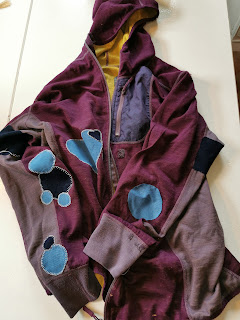
I have altered a few sweaters this way and I also made a jacket out of a hoodie.


My most fun alteration was a pair of ugly crocs that I covered with crochet.
And they turned into cool slippers with flowers. These are now lovely to look at too.


For more crochet hack inspiration
CHECK out Emma's account @steelandstitch Emma has even wrote a Book about it
Where I love to use crochet
As I seem to have longer arms than the ‘average’ mender I often make the sleeves longer by adding a little crochet feature to them.


You can also make crochet motifs and use them as patches.
I like to also use small crochet flowers to cover small stains or holes.
Like the ones used for one of my favourite tops

I made a pattern for this
They are actually very simple to make.
You need a little bit of yarn. I used 2 colours but you don't have to. And a crochet hook.
You start by chaining 4 stitches slip stitch to a circle, or make a magic circle if you prefer.
Crochet 16 single crochet in the circle. Slip stitch into first single crochet.


Make 2 chain stitches in the first single crochet. 2 double crochet in the next stitch. 2 chain stitch and single crochet in the next. Repeat 7 times singel crochet into the same stitch you started.

If you need a bigger flower 🌸 use a thicker yarn or make more petals by adding single crochet stitches in the 2.row each petal needs 2 single crochet stitches.
You can make various kinds of flowers using treble crochet or double treble crochet stitch. Or make clusters or popcorn stitch instead.
I have made a variation with 3 double treble crochet clusters and 7 chain stitches.
And one using double crochet cluster.


Granny Squares also makes great patches.
And you can crochet together several to make bigger patches. These are also great if you have some left-over yarn you want to use and don’t want to waste. I also make other small motifs or doilies and use them as patches. Remember to choose a yarn that will work well with your fabric, because if you choose one that is too bulky or it might be too heavy for your fabric, and it will not look good. It won’t blend into your garment, unless you are aiming to have a mend that is very, very visible.
I think crochet patches fit well with jeans. They stand out really well.
I used a variegated cotton thread to crochet some granny squares to cover up some paint stains on Hilma's jeans.

Pattern to the granny square
As I said earlier, you can make bigger patches by joining them together. I made a bigger patch out of 6 granny squares.


There is a jeans jacket I bought second-hand. I made a crochet panel in the sides as it was a bit too small for me but I loved this jacket so much. I planned to add some embroidery on the back of this jeans jacket, but haven’t gotten around to do it as yet.

If you don’t know how to crochet, you can often find crochet doilies in the second hand store and use those to create beautiful visible mends.
Here is my Christmas table cloth story
Here is a little Christmas inspired mending for the December episode of Seworganisedstylepodcast

I have this huge Christmas tablecloth. My mother-in-law started embroidering it together with her husband. They did not finish their embroidery, and she passed it on to me, so I could finish it.
This was way back when I was in my early twenties.
Unfortunately there was a needle that was left in the embroidery of this tablecloth. The needle had rusted an was stuck in the middle of the table loth. So I couldn’t get it out without making a hole in the tablecloth. I can’t remember exactly how this happened but the area around the needle was also damaged. Maybe the needle was pulled through the fabric several times? And it grew bigger as I was embroidering. Why didn’t I think about fixing the hole when I first saw it?
It was of course very annoying to me because I then had spent so much time sewing it.
And I got all family members to embroidery a star each.
So after all of their efforts I though
t to myself that ‘I must fix it’.
I wasn’t as experienced with mending back then as I am today.
And I used an under patch and darned it with the sewing machine I did not have a similar thread at the time, and I sewed over this hole too many times. It really is not very pretty. I wish I had asked my Mum to help me out back then. But this mending kept this hole from growing larger and this has kept the tablecloth together for ever since.
I have recently covered that ugly darn with a crochet doily and a Christmas flower.
Every year when I used to iron this Christmas tablecloth and used to think ‘oh bugger I forgot to fix this ugly darn’. But right now I don’t have the time to fix this tablecloth……. So I’ll do it next year.

So I said to Maria @velosews I’ll make do this mend for the December podcast.
I must say I do regret it.
This mend has given me a lot of trouble, and headaches.
First off all I had to remove my old darning, and this wasn’t easy to do. As I had to try to not have the fabric fray even more around the hole. But this stage of the darn worked out pretty well.

I then thought to try to darn the holes to look pretty by hand darning or maybe cut out the damaged area and put a crochet doily in the middle.
I was trying to find a thread to match the linen fabric, but after been through my entire stash, which is actually more like a craft store, I couldn’t find any. I tried with the closest thread I could find, but I didn’t like how it turned out.
Next I tried to find linen fabric that was somewhat similar to the one in the table cloth. Again, no such luck either. Yes. I even tried to bleach one linen piece to see if it was a better match with this tablecloth.
I kept searching through my other tablecloths to try to find something that could work out. But no,nothing matched up with this one.
Then I tried to find a crochet doily that could fit this hole in the tablecloth.
Either the ones I had were too big or wasn’t good enough for a centre piece of this tablecloth.
I looked through my local second-hand shops, no luck there either....
I had given up on finding something that would work the way I had thought. Deciding to crochet a piece myself. And I started a piece. But I’m not really happy with the pattern I chose.

I spent most of November trying to get something to work with the tablecloth mend. Thinking I just had to say to Maria I couldn’t fix it. Or I just had to go with a patch that didn’t fit and just trying to embroidery over it to cover up it didn’t fit. I really wanted this to be as invisible as possible.
But then looking for something else in the second-hand store, I stumbled upon a tiny tablecloth with a close colour and a little embroidery that I thought would work.
It was the best match I had found, so I went with it!

First I made a paper piece checking where it was placed, and how big this darn needed to be.

There was no room for mistakes, as I only had the one small tablecloth to use.
Then I cut the patch using the paper template.

Zigzagging around the edges.
Folded in the edges as I don’t want the rest of the holes to fray more I used thermofix. It’s a backing with glue on both sides. Often I use this in applique. You iron it on. When my patch was in place I topstitch the patch. And now my large tablecloth is finally ready for Christmas.


It just took me almost 30 years to get it done properly...
After I was done I got an explanation from my friend why it was so difficult to find a matching fabric or thread for the table cloth. She told me that they often used flour sacks to embroidery on quite some time after the second World War.
I think that might be the case, my husband can still remember his mum embroidery on it just before Christmas. He said he think it was passed on to her from someone, and she might had started it before he was born.
I’m very pleased I finally managed to get this done. All thanks to Maria and seworganisedstylepodcast.
Be sure to check out our give away over at our Facebook page.
To participate the only thing you need to do, is to like our Facebook page. When it reach 500 likes we'll draw one random person who likes our page, who will get this lovely mending kit.


Have a lovely day flowers 💐
Stay safe and well.
Katrine 🌼
Text mended to better English by Maria