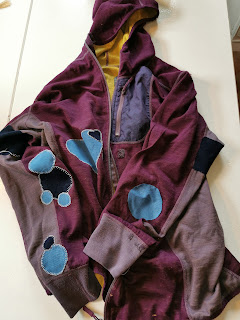
Thursday, November 5, 2020

Mending techniques


Today we are looking at 4 different mending techniques – Sashiko, embroidery, sewing patches and applique.

Listen to the new episode with me, Katrine from Mendingmayhem at seworganisedstyle podcast Recorded by Maria

Visible mending is a fun creative way to preserve clothes. 

There are so many fun techniques to choose from.  Mend don’t spend. 

Sashiko


Sashiko is an old Japanese way of decorating and mending clothes.

Sashiko means little stabs.

From what I have learned, Sashiko seems to refer to the stitching process itself, whilst Boro is the final textile result of patching and repetitive Sashiko stitching. Together they form a unique textile visible mending art piece. 

Most people I know creating visible mending know more about Sashiko than I do.

You can find Sashiko used in many forms from the simple running stitches back and forth through a patch, to intricate patterns.

Common motifs were originally inspired by natural surroundings like ocean waves, mountain peaks, and fields of grass-resulting in concentric circles and geometric patterns with poetic names such as persimmon flower or pine bark.

Simple tools are used - a long needle, heavy weight cotton thread, and a Sashiko thimble.


To avoid any discussions about how my work follows or doesn’t follow the traditional techniques and tools, I always say my mending is Sashiko-inspired.

After all I’m a maker and an artist so I may not following rules as a true Sashiko expert.

And I like to use whatever I have at hand. To be honest I have never owned any Sashiko threads or thimbles.

And I’m horrible in sewing straight lines but I am very talented in making uneven stitches and I often cheat a bit too. 

Luckily there are some people that are way better with Sashiko than me and I enjoy seeing their work.


Kirsty from @spiderweavestudio Who was guesting for Mendingmayhem  back in October is making some beautiful Sashiko mending.

Here are some pictures of her lovely work.

Amazing rice flowers stitch on a linen top to strengthen it, by Kirsty. 


Mended linen trousers using Sashiko, by Kirsty. 


Beautiful Sashiko pattern on a linen shirt, by Kirsty

Selina from @selinaam05 Who is sharing traditional Sashiko knowledge. 

Showing a few pictures of Selina's beautiful Sashiko stitching.

Jeans mended with a cat patch, beautiful work by Selina. 


Selina makes her own pattern as well, this foxes are adorable. 


Beautiful shirt mending by Selina 


Beautiful patch stitched with traditional sashiko pattern. By Selina.


She also found inspiration from Lindsay @lindzeanne . Very talented textile artist living in Japan . Lindsay uses sashiko inspired work in her art using recycled materials   and actually one of the first guest post at Mendigmayhem . She has a lot of impressive work , and some handstitched beads that are totally amazing.


Also, I would like to mention Eva Kittelsen from @myvisiblemend you will find her earlier work over at @Evakittelsen Norwegian textile artist who uses a bit of Sashiko in her mending.

Eva also has a lot of gorgeous and breath-taking embroidery mends. Caring a lot about sustainability and the environment. Aso she does mend in public. It’s a great way to get people interested in the mending movement.

Pictures of Eva's work

Pile of beautiful mended trousers and jeans by Eva 


Eva mending in public on the subway in Oslo. 


Fabulous embroidery knee mend, embellished with sequins, by Eva. 


Bees for Eva's husband's stained nice shirt 
Isn't this one just brilliant? 


Embroidery

Embroidery has existed, in many forms, in every population across the globe. Whether it’s displayed on clothing, home goods, or as an artwork, embroidery is a timeless craft and is an essential part of our material culture.

The definition of embroidery is the art of applying decorative designs onto fabric using a needle.

Menders often use embroidery to cover up a hole or hide stains or simply to embellish their work.

There are a lot of different stitches to choose from and so many ways to use it.

I seem to have been using embroidery many times recently. I used to prefer to use my sewing machine for mending, as it’s much faster. Now I have found myself enjoying hand stitching more and more.

It’s something about the quietness and the slow process that makes you unwind and relaxed.


What tools you need to embroidery mend? 

Needle 

Embroidery thread - Cotton or wool depending on what material you are mending.

A pair of embroidery scissors

An embroidery hoop can be helpful

If you are making a pattern or design you might need a tailor's chalk pencil or a transfer paper.

Beads or sequins can be added for more decoration.

I like to make embroidery patches and sew them on after I’m done with the motif often using running stitches creating a Sashiko like pattern.


Since I used to make a lot of jewellery in the past, I tend to use beads in some of my embroidery because I still have a lot of them and they do look good on some garments. Like the sweater I’m still working on for my Mum.


You have to make sure to attach the beads securely. I use a double sewing thread, and small stitches.

Techniques are often used mixed when you create visible mending. The techniques are all determined by the artist.

I might have mentioned the sisters Jen and Wendy from @bostonandyork earlier, but they are defiantly worth mentioning again as they have so many brilliant stitching tutorials on their profile. 

And a lot of beautiful mending and embroidery.

Pictures from Jen and Wendy's work


Denim skirt embroidered with woven wheels by Jen and Wendy 
You will find a tutorial on how to make this in their tutorial Here


Patched and embroidery mend by Jen and Wendy. 

Kitty apron mend by Jen and Wendy. 


Beautiful pocket mend with embroidery by Jen and Wendy. 

Vera from @reparierenisliebe mostly use embroidery in her mending and she does it very well.

Pictures showing Vera's marvellous embroidery mends

Beautiful unicorn patch embroidery by Vera 


Amazing fox embroidery on hat by Vera 


Chicken instead of a hole by Vera 


Amazing embroidery badger on hat by Vera 

Embroidery on favorite sweater by Vera. 


Inger from @ingerfrimodig also has a bit of embroidery work, even a pair of garden gloves.


Teatowel mend by Inger. 


Even Inger's garden gloves needs a bit of embroidery mending


Inger mends everything, even her floor cloth


Patching  

Big butt patch 


Patching could simply be placing a patch to cover a hole. You can apply the patch either on the inside of the garment or outside.

There are many ways to use a patch. You can make it stand out or try to make it almost invisible.

I think most people will be familiar to patching a hole. And it might sound a bit dull. 

What tools you will need to patch a hole?

Needle 

Sewing thread or embroidery thread

Scissors 

Or a sewing machine if you prefer.

Patches from fabric, you can use other worn-out clothes to make patches.

A few pins to secure the patch in the right place.

Fusible interfacing

I do recommend the patch fabric is somewhat similar to the fabric in your garment. 

The patch needs to be bigger than the hole, and sometimes there will be weak areas around the hole so you might want to make a much larger patch to prevent a new holes to emerge.

Remember, you will need to secure the edges of your patch before attaching it. This can be done using zig-zag stitches using a sewing machine or use fusible interfacing or you can fold in the edges of the hole.

Sewing by hand you can use blanket stitch around the edges. This can be done while sewing the patch onto the garment.

Some fabric won’t fray for example knit fabric don’t fray easily and so you don’t need to secure edges for holes in knit fabrics.

Patch sewing tips

Pin the patch in place and start sewing it on.  Either by hand or machine. 

Often jeans and trousers will get a hole in the knee and it’s difficult to get to by using your sewing machine. A good tip is to open the side seem a bit to get better access, then sew it back when you are done.

Another good tip is to use motifs from old clothes as a patch. Children often have favourites and then they grow out of their clothes. And they do often appreciate having their clothe patched with their outgrown garments.

You can find a tutorial on how to patch in this earlier Post and Here

Talking about patching we must mention Erin from @gatherwhatspills who hosted the #mendmakefriends#mendmakefriends patch swap and uses a lot of patches in her mending

Well loved jeans patched by Erin. New patch will soon be added

Kneemend by Erin

Erin keep her mending supplies in small baskets and pouches so everything is portable. That way she can just grab a bag and a project and work on her mending everywhere.
 

Marte form @marte.unikumdesigen often uses worn out or outgrown clothes for patches.


Marte used an old night gown to mend this leggings.


Marte's favorite way to spend a Friday evening, doing some mending of course.


Band aid or in this case a patch covering a hole

Clothes repair from Marte in use.

The same goes for Hanne from @bananasandgreen 

Well worn denim shirt with elbow patches in silk. Mended by Hanne. Silk restovers passed down from a friend 

Pants mended using patches from old clothes. Hanne like to use what she already have. 


Patched jeans by Hanne

Candy @heartfulstitches is very often also using patches, and likes to attach pockets to everything. You can’t mention Candy without talking about her marvellous post stamp quilt.  #candyspoststampquilt Hand stitched from tiny pieces of fabric, embroidery quotes from her children, family sayings, memories, jokes, songs and drawings. Last time I checked it had around 3,350 pieces

Candy loves pockets and if something doesn't have pockets she will make some. 


Patch work by Candy 


Candy's marvellous poststampquilt. 

Marissa from @andwearis often makes a little applique from some of her patches. That girl seems to be able to reuse anything.


A bag that had a big stain on it, so Marissa covered it with these cuties.

Marissa's son's sweatpants that have both knees mended, and the monkey initially was just the head, but she had to add the body when a new hole appeared. These pants have lasted over 2 years on an active boy thanks to mends!!


Applique

Applique is a technique where pieces of material are attached to a larger piece of material, often in a decorative pattern. These patterns can include lettering, geometric shapes, or images. Often, the two materials used will contrast in type, colour, and/or texture so that they can be easily differentiated.

Common applique fabrics include felt, fleece, and quilting cotton, but applique can be accomplished with almost any material! Applique is often used to add colour, texture, or embellishment to a piece

This is a very fun technique and you can make almost anything you like.

I used to create appliques when I first started to mend, but not so much lately, I think I need to revisit this technique again.


Raven mend on leggings, hand stitched and decorated with a little embroidery 


Well worn fleece jacket got some applique birds and a cat to hide wear and stains 


Bag mended with a applique patch 


You can use applique directly on your mending project or make a patch with it first. 

I think it’s a good way to mend t-shirt or leggings' where you don’t need any backing on the fabric pieces. This techniques does need a bit of work if you are cutting out small pieces and iron on interfacing. 

The motif can be sewn on by hand or machine 

Stephanie from @swoodsonsays uses a lot of applique in her mending. Making unique pieces of garment that is often better than the original.


Cute applique rainbow mend with heart by Stephanie.


Bunny knee mend by Stephanie.


Mending kids clothes


T-shirt upcycled to a knee patch by Stephanie


Cat knee mend from Stephanie
Cat knee patch template


You also have the reversed applique technique there you put a piece of fabric underneath, draw a motif on the top stitching around and cut out the top fabric. It can be a bit tricky to use for mending as the motif must fit the hole or stain. And it works better with t-shirt fabric or non-fraying fabric.


I have used it for mending leggings and t-shirts.


Find Mendingmayhem on Facebook


Mendingmayhem Facebook group 


Pictures are published with permission from the makers. 


Sunday, October 11, 2020

Jeans repair, using a under-patch


Time for another jeans mend. 

My hubby came with his well-worn jeans, hoping to get them repaired. 


Even they had a lot of wear and very thin fabric, I thought they would last a while longer. 

Instead of using an over patch like last time, I went for a under patch this time. First, I cut a patch from some left-over fabric, making sure it would cover the entire worn area. 


Then securing the edges using my serger, you can use a regular sewing machine and zig-zag seam or scallop scissors. 

 Turning the jeans inside out to put the patch in place with pins. 


Then turning them again to start stitching. I put a quilting ruler inside the leg, to make sure I didn’t stitch through the back side of the leg. A good tip I got from Tricia, @morrissews


Earlier I have used a small book, or a small chopping board. 


 Sashiko does look good on jeans. Now I’m not very good on following rules so I keep to sashiko inspired. 


Here it’s only running stitches.  Making a different pattern this time.  


When done in one direction, stitching in the other direction, making a stitch from one of the previous stitches to the next. Then under the next.  Keep this up until you reach the end the. In the next row, you make sure your top stitch is in the same place as in the previous row. If you are more accurate than me you will have nice squared boxes. Keep it up until you have done all stitches. 


Now my hubby’s jeans just need the other leg repaird ,but  your jeans are ready to wear again. 


This pair of jeans had a hole in the butt too.  


It’s darned using thick sewing thread and some variegated embroidery thread. 


You can learn how to darn in our post about Sock darning.  


Thursday, October 8, 2020

Second hand sewing notions


Have you ever considered buying second hand mending and sewing notions?

 If you have listed to the new episode from Seworganisedstylepodcast.com you can hear Maria and me discussing second hand notions


I have always loved second hand items, seeing value in what other people think is thrash.

To my mum's despair.

It was when I meet my husband, and got introduced to his mother, I really got into second hand shopping. 

Mary my mother in law was a dedicated second-hand shopper, and even with an age difference over 60 years apart. We had so much fun roaming flea markets in Oslo, the capital of Norway.

I learned very much from her and she was a master to get good bargains. And knowing where to find all the good stuff. I found my first sewing machine in a flea market paying 100 kr for an old Singer. It just needed a new screw for the needle, and a good clean. 


When we moved to our current home outside Åndalsnes , the opportunities to find second hand items was drastically reduced. Being a small rural place there wasn't really any second-hand stores or flea markets. It was still a bit shameful to by second-hand.

Luckily things have changed   


Mostly I find most of my craft supplies second hand. Of course, I sometimes need to buy something new. But since I have a dedicated Crafter, I have a large haberdashery. 


Why do I buy second hand?

Firstly, you can save a lot of money.

 Craft supplies are expensive.

Reuse and recycle to keep things from landfills

Finding vintage and special items. 


If you just started to look for second hand notions, here is how I find mine 

Tell your family and friends about it. Often, they have things that they will donate to you.  Or they know someone that might have something for you.

I always tell people to come with everything, and I will sort out what I can use. Often people who aren't mending, sewing or do crafts, do toss the items we would like to keep. 

Look in second hand shops. 

Flea markets

Markets there they sell second hand. 

Garage sales etc 

Online, Facebook sale groups, Esty, eBay, other sites where people advertise to sell stuff. 


What am I looking for? 

Good pieces of fabric. Like curtains, duvet covers tablecloths

 are often cheap and gives you a lot of fabric. 

I'm looking for good quality fabric. Cotton, Linnen and wool, denim.

 Also, I like to find embordered tablecloths and embroideries that I will later use for patches or refashion.

Sewing and embroidery thread 


Knitting and crochet yarn  

Before the pandemic I would have advised you to use your senses when buying second-hand. But I will not recommend you to smell and fell fabric at this time.

Instead you will need to use your eyes more. And you can still smell if the shop smells clean or mould. I strongly recommend not to by fabric or things you can't give a proper wash in a store that smells bad. If you smell mould, I really never buy anything. 

It would be really sad to bring home a fabric that ruins the rest of your haberdashery.

When you are looking for fabric, check them for wear and tear, not all second-hand stores are very good at sorting out rubbish.  If a piece has a hole or a stain, you might still be able to use it. Cutting around it. But if you intend to use the entire fabric, give it a good check. Well-worn fabric isn’t something you need to bring home either. Miscoloured fabrics is a big NO. I also sometimes buy clothes for refashion or just because I do like the fabric. 

Jeans are a good source for denim, often you can find some really cheap.  Look for the biggest size and I prefer sturdy denim, not the stretchy kind. Also look for different colours and patterns to keep a nice variety of denim. Again, check for holes and stains. I don’t mind holes and stains when people donate, but not so much when buying. 

When buying wool, check for moth holes. You don’t want to invite those nasty creatures into your home. Unless you are more dedicated to mending than me 😉 

Tablecloths are the one time I make an exception and might by even if stained and lots of holes.

I’m totally addicted to old hand embordered tablecloths, and feel I need to save them all. 

Everything you bring home should be properly washed before you start to use it 

Other good items to look for are, ribbons, lace, bias binding.


Sewing and embroidery thread, crochet and knitting yarn are something I’m looking for. Though be aware you need to check it. 

If the thread snaps and makes a crisp break, it's okay for you to use it. However, if it pulls apart slowly and easily, you should not buy it.


You can’t wash yarn and thread, but what you can do is to put it in the freezer. At least 14 days, but probably I leave them for one month. Of cause you don’t need to if you see it looks brand new, or you know where it came from. Just use common sense.

Sometimes you will find something smelling of mothballs, if it’s a fabric you might get the smell out, but if it’s not something very special, I find it’s really not worth the effort.

Ways to get rid of mothball smell.

Soak the affected garments in a solution of equal parts water and vinegar. Alternatively, put the clothes in the washing machine and run a cycle using only vinegar; follow up with another wash cycle using detergent and softener.

 Put it in a bag with baking powder and seal the bag. Leave it for at least a week. 

 Put it in the freezer for one week or more.

Hang it outside on the clothesline until it’s odour free.  This takes for ever

And most likely you can still smell the mothballs.


Embroidery frames, often second-hand shops have a lot of framed embroidery work that will be very cheap. Those work excellent as an embroidery hoop. Just remove the embroidery and the eyelet screw to hang it on the wall. Those frames come in a variety of shapes and sizes. Sometimes the embroidery is glued to the frame, but so far, I have just put them in hot water over night and they all came loose. 


Buttons, are good items to find.  Often you can find jars of buttons in the store. If you are buying loose buttons, remember you often need several of the same kind. But do by all means by the lonely but absolutely gorgeous one.   

Zippers yes, vintage zippers are often better than new once.


Darning mushrooms, thimbles, rulers, pins, wonder clips, needles Are all good items to find .

Sewing Machin needles, unless they are in an un opened box, NO 

Scissors maybe, embroidery scissors you can always manage to sharpen. Fabric scissors should only be used for fabric, and you don’t know what it has been used for. But if it’s cheap and you feel like taking a chance, you might be lucky.

Elastic absolutely not. 

Patterns and books are great finds.


Sewing boxes are another treasure to find.  just check that it’s in good condition. And don’t have holes from wood eating bugs.


If it’s wooden box you can give it good clean with water and soap. 

If you can’t use water, you can use compressed air, you can get small cans so you don’t  need a compressor .

Baskets for easy access to your favourite projects, and for easily bringing them with you 

All kinds of other sewing accessories that you can find, knitting needles, crochet hooks, tape measures, needle cushions, Irons, iron boards etc  

 Storage for your sewing notions. Second hand stores often have a variety of boxes and tins.


Mason jars are one of my favourites.

Shelves for all your  mending and sewing books.

Desks and tables if you are creating a new sewing space.

All the furniture in my sewing room are bought second hand.


Find Mendingmayhem on Facebook

You can also join our Mendingmayhem group. 


Katrine 


Wool jacket repair

  I was asked if I could mend this double wool jacket. At first the owner only thought it was a few holes in the sleeves but discovered a bi...